
Key Takeaways
- The portfolio second opinion can be treated as a defined acquisition workflow, not an ad-hoc review, to support consistency and scalability.
- Manual data ingestion from prospect statements can create operational bottlenecks that limit the efficiency of second opinion preparation.
- A second opinion report can provide a clear, data-driven analysis of a prospect's holdings, fees, and risk.
- Standardizing the analytical baseline and report format across a firm can improve governance without dictating an individual advisor's investment conclusions.
- A report built around objective data points gives the advisor and prospect a shared factual reference for the conversation that follows.
Advisory firms may at times use a portfolio second opinion as part of the prospecting process. A prospect may share current statements, and the advisor or their team may conduct an analysis that gives both parties a clear, objective view of the current portfolio. In that context, it can be a consequential touchpoint in the acquisition process. Some firms may also find that this function is handled through an informal, ad-hoc process.
Each advisor may pull data differently, spend a varying amount of time on preparation, and produce outputs that differ in depth, structure, and format. When preparation time is not tracked as a distinct workflow, firms may have limited visibility into the resources required for each engagement. Firms that treat the second opinion as a structured acquisition process can begin to estimate the resource cost per prospect engagement and make informed decisions about where to invest in process improvement.
This article explores how advisory firms can structure portfolio second opinion preparation as a repeatable acquisition workflow. The goal is to establish firmwide consistency in how analysis is prepared and presented, enabling growth without dictating investment conclusions.
What a Portfolio Second Opinion Workflow Is and What It Is Not
A portfolio second opinion workflow is a structured, repeatable process for moving from prospect data intake to a client-ready analytical output. Where an informal portfolio glance during a discovery meeting offers an initial impression, a defined workflow provides the analytical preparation that informs the advisor's follow-up conversation.
Consider a hypothetical firm where two advisors receive similar prospect statements. One advisor manually re-keys holdings into a spreadsheet, runs a few comparisons in one tool, and builds a slide deck in another. Their colleague uses a different analytics platform and focuses primarily on risk metrics. Both produce a financial advisor second opinion , but the outputs are inconsistent in their depth, format, and the time they take to create.
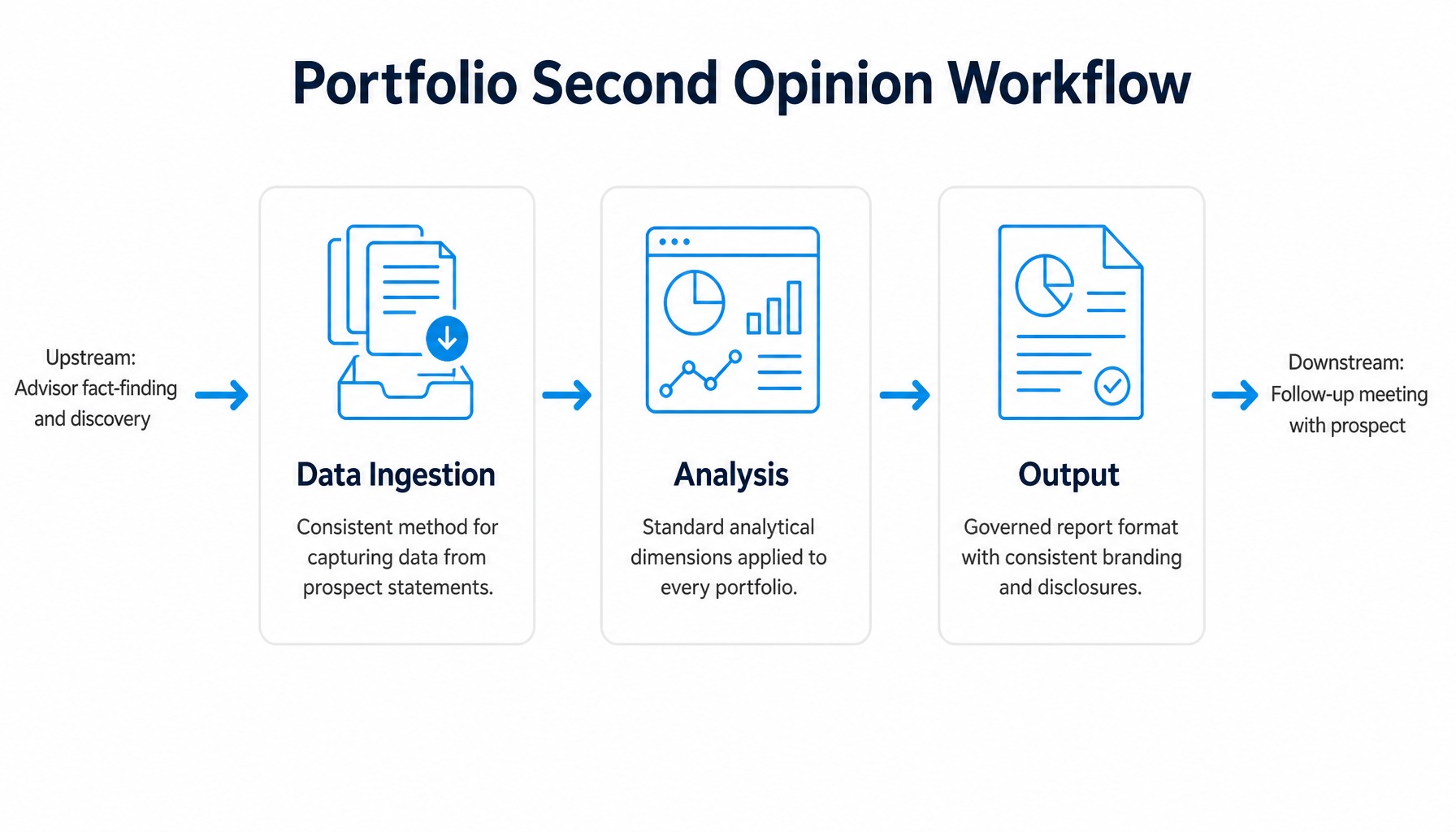
A workflow establishes a defined path:
- Data Ingestion: A consistent method for capturing data from prospect statements.
- Analysis: A standard set of analytical dimensions applied to every portfolio.
- Output: A governed report format that keeps branding, disclosures, and structure consistent.
This process does not replace the advisor's judgment or the discovery conversation. The advisor's fact-finding process happens upstream, gathering context about the prospect's goals and circumstances. The analytical workflow sits between that discovery step and the follow-up meeting, equipping the advisor with objective portfolio insights to inform their recommendations. What distinguishes a workflow from an ad-hoc review is largely its repeatability.
Data Considerations for a Portfolio Second Opinion
The quality of a second opinion is shaped by the quality and completeness of the data behind it. Prospect information may be incomplete or distributed across multiple accounts and institutions, including a few statements, a partial view of allocation, and limited visibility into cost basis, fee schedules, or held-away assets across custodians. A separate consideration is how that information is gathered and organized without creating an operational bottleneck.
Core Analytical Inputs: Holdings, Fees, Risk, and Allocation
Depending on the scope of the analysis, relevant inputs may include:
- Holdings: A security-level view of the current portfolio.
- Asset Allocation: A breakdown of the portfolio's exposure across asset classes and investment styles, often including style-box analysis.
- Fee Structure: A multi-layered analysis of costs, including advisory fees (often found on an ADV Part 2), fund-level expense ratios, and other embedded costs that create basis-point drag.
- Risk Exposure: An assessment of the portfolio's risk profile relative to the prospect's stated objectives and tolerance.
- Cost Basis: Where available, cost basis and tax lot data, which add context on the unrealized gains and losses across holdings.
- Held-Away Assets: Information on accounts at other institutions, such as 401(k)s or deferred compensation plans, to support a more complete household-level portfolio view.
How Data Ingestion Can Create a Bottleneck
One potential operational challenge is getting the relevant data into a usable format quickly and accurately. Prospect statements may arrive in formats such as PDFs or printed documents, creating manual data-entry work when automated extraction is not available. This friction can be a significant upstream constraint on how many second opinions an advisor or team can realistically produce.
A firm may find that its advisors spend meaningfully different amounts of time preparing second opinion materials. In a hypothetical example, a firm that tracked preparation time across its advisory team might see a range from roughly ninety minutes to over four hours per prospect, with no clear correlation between time spent and conversion outcomes. In a case like that, much of the variance could reflect differences in how each advisor gathers data and structures the analysis.
For prospects whose accounts are not connected to the firm's systems, custodial feeds may not be available. Their statements may remain the starting point. A scalable second opinion process, therefore, can benefit from a dependable way to bring prospect statement data into the analysis, one that reduces the manual effort involved in preparing each review.
Potential Components of a Second Opinion Report
Objective, clearly presented portfolio data can provide a useful foundation for a second opinion conversation. A report built on clear, comparable data presents the analysis on its own terms, which helps it read as a consistent, transparent assessment of the portfolio.
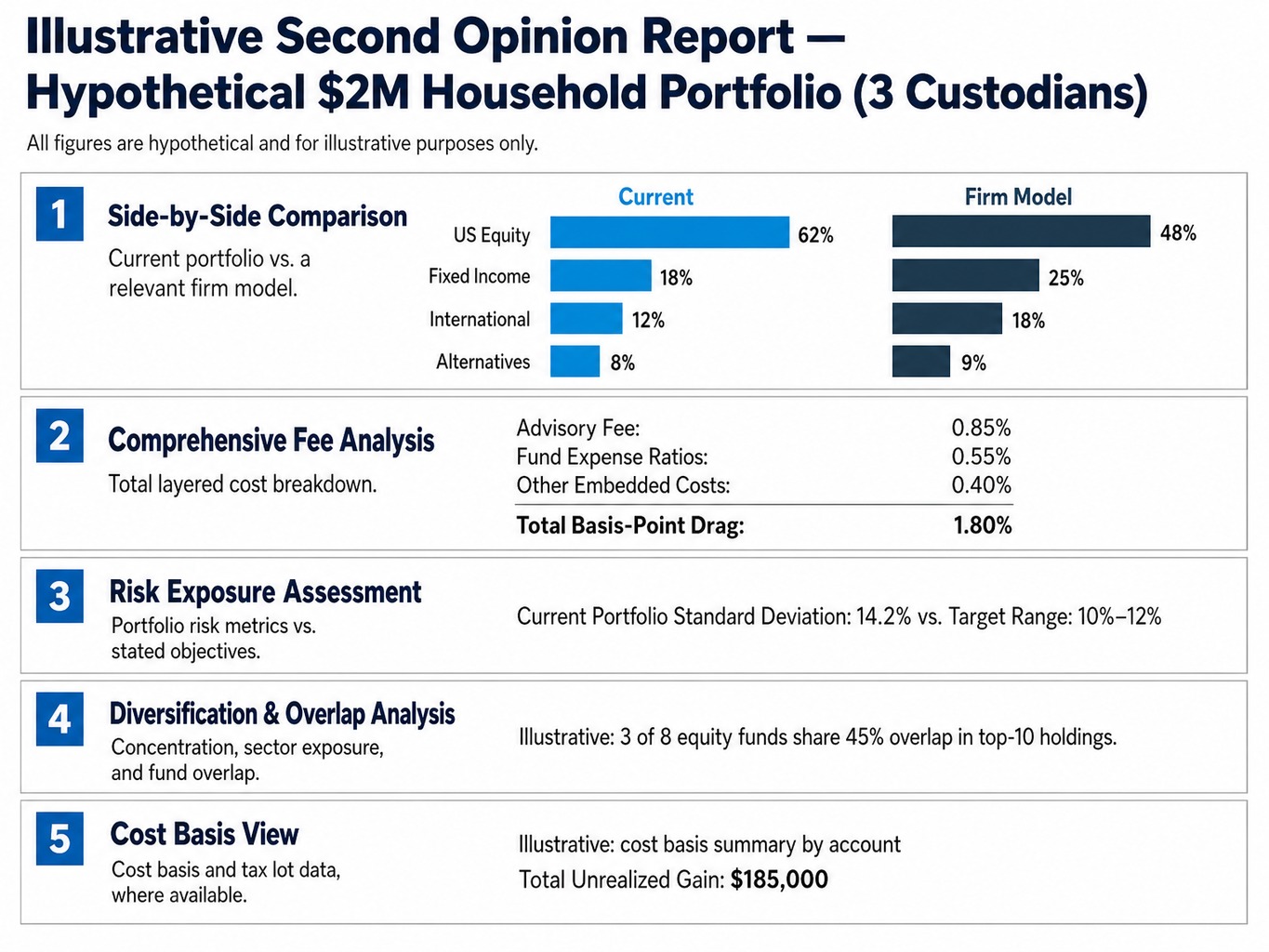
Consider a hypothetical prospect with a $2 million household portfolio spread across three different custodians. An illustrative consolidated analysis, based on the data available, could show a household-level view with identifiable fee layers and risk exposures mapped against the prospect's stated tolerance. Its role would be to describe the current portfolio clearly, providing a factual basis for the advice conversation that follows.
Components that may contribute to a client-ready output often include:
- Side-by-Side Comparison: A clear comparison of the current portfolio against a proposed allocation or a relevant firm model.
- Fee Analysis: Reviewing available advisory fees, fund expenses, and other identifiable portfolio costs.
- Risk Exposure Assessment: An analysis of the current portfolio's risk metrics (such as standard deviation or drawdown potential) relative to the prospect's stated objectives.
- Diversification and Overlap Analysis: A review of portfolio concentration, sector exposures, and portfolio overlap analysis between funds to identify unintended bets.
- Cost Basis View: Where cost basis and tax lot data are available, a summary of unrealized gains and losses across the current portfolio's holdings.
The report's format, branding, and disclosures also matter. A clearly designed, white-labeled proposal or report presents the analysis in a consistent structure that prospects can follow. Standardizing this output helps establish a shared presentation baseline, with consistent branding and disclosures that the firm's compliance team can review.
Read more: How to Create Winning Proposals: 3 Tips for Advisors
Structuring Second Opinion Findings as Objective Analysis
Objective, evidence-based analysis can help create a stronger foundation for a second opinion conversation. A structured report can establish a factual analytical foundation that advisors use to inform their own observations and recommendations.
Structuring findings this way places the emphasis on the data itself. For example, imagine a fee analysis that shows a prospect is paying 1.8% in total layered costs. In a structured report, the figure would appear alongside a breakdown of the components it includes. That level of transparency would give the advisor and prospect a shared factual reference point for whatever conversation follows.
The report itself contributes to this objective framing. A consistent, firm-branded deliverable documents the analysis as the output of a defined process rather than an individual opinion. It can also make the firm's analytical methodology visible, showing how the data was gathered and evaluated.
Scaling the Second Opinion Process Across a Multi-Advisor Firm
For a solo advisor, maintaining a consistent second opinion process depends largely on individual habits and available time. For a firm with ten advisors across three offices, it can become a governance question. Without a shared process, firms may encounter variation in the depth, format, and disclosures of second opinion deliverables from one advisor to the next.
The goal of scaling is not to standardize what advisors recommend but to standardize how the analysis is prepared and presented.
Consider a hypothetical multi-office firm that discovers one office produces detailed, branded second opinion reports while the other sends prospects a one-page allocation summary. This inconsistency may reflect a workflow gap rather than a difference in investment philosophy. Closing that gap can involve:
- A Shared Analytical Baseline: Establishing a shared set of analytical measures that advisors can apply based on the scope of each engagement.
- Governed Templates: Using controlled proposal workflows and templates to help keep branding, disclosures, and report structure consistent.
- Firmwide Visibility: Giving leadership visibility into analytics and reporting activity across advisors, teams, and offices.
In practice, a shared process means the firm's second opinion output follows the same structure regardless of which advisor prepares it. For firms looking to scale their financial advice practice , this kind of process consistency can support capacity as the advisor team grows.
Read more: Operational Visibility for Wealth Management Growth | VRGL
How VRGL Supports a Repeatable Second Opinion Acquisition Workflow
The challenges described throughout this article, manual statement processing, fragmented analytical tools, inconsistent report formats, and limited leadership visibility, are operational friction points that a structured workflow can help address. A structured acquisition workflow can support repeatability, visibility, and consistency across the second opinion process.
The VRGL Growth Platform connects several of the workflow stages discussed in this article while keeping advisor discovery and investment judgment separate from the analytical preparation process.
VRGL Statement Extraction helps convert prospect statements into structured data, reducing the manual effort involved in preparing a second opinion when account data is not already connected to the firm's systems.
VRGL Core supports consolidated portfolio analytics across accounts and households, helping advisors review holdings, allocation, fees, risk, and diversification in a single analytical workflow.
The platform also supports client-ready proposals and reports, allowing firms to present analysis in a consistent, firm-branded format that can be configured to align with the firm's presentation standards.
For larger advisory teams and enterprise environments, VRGL supports firm-level configuration and consistency across advisors, teams, and offices, helping leadership maintain visibility into analytics and reporting without dictating advisor conclusions.
In that role, VRGL serves as technology that supports how firms prepare, analyze, and present second opinion analysis.
See how VRGL supports your firm's acquisition workflow
Conclusion
The portfolio second opinion functions as an analytical workflow that can be defined, governed, and repeated. Replacing manual, disconnected preparation steps with a defined workflow can give firms a way to bring more consistency, clarity, and speed to this acquisition activity.
A structured workflow can reduce manual preparation work and support greater consistency as prospect volume grows. For prospects who value data-driven, transparent analysis, a repeatable second opinion workflow can provide a clearer and more consistent starting point for the advisory relationship.
This content is for informational purposes only and should not be considered investment, legal, tax, or compliance advice. VRGL is a technology provider and does not provide financial or investment advice, make investment recommendations, or act as a fiduciary.
Frequently Asked Questions
1. How does a portfolio second opinion differ from a full financial plan?
A second opinion is typically narrower in scope, focusing on evaluating a prospect's current investment portfolio across dimensions like allocation, fees, risk, and diversification. A comprehensive financial plan is broader, often including cash flow projections, estate planning, insurance analysis, and retirement modeling. Some firms use the second opinion as an entry point that may lead to a full planning engagement.
2. What compliance considerations may apply when providing a portfolio second opinion to a prospect?
Firms may want to consult their compliance professionals regarding the policies, disclosures, and recordkeeping obligations that may apply to second opinion materials. The specific considerations can vary based on the firm, the nature of the materials, and the firm's regulatory oversight.
3. Can a second opinion workflow support growth for firms with multiple investment philosophies?
Yes, provided the workflow standardizes the analytical process and output format rather than the investment conclusions. Advisors with different philosophies, for example, active versus passive or model-based versus custom, can use the same data ingestion, fee analysis, and risk assessment framework while arriving at different recommendations. The consistency is in the preparation and presentation, not the advice itself.
4. How do family offices use second opinion analytics to evaluate outside managers?
Family offices sometimes apply a second opinion framework to assess the performance, fee structure, risk exposure, and style drift of external investment managers. Rather than evaluating a single household portfolio, the analysis may cover multiple manager relationships across asset classes, looking for overlap, concentration, or fee layering that is difficult to see without a consolidated view.
5. What metrics can advisory firms track to evaluate their second opinion process?
Firms can track the number of second opinion analyses produced per period, the time from data receipt to completed report, and the consistency of report structure, analytical coverage, and preparation workflows across advisors. These metrics can help leadership identify bottlenecks and assess whether the workflow is operating as intended.
6. What role does held-away asset data play in a second opinion engagement?
Held-away assets accounts the prospect holds at other custodians or institutions are often relevant because they affect the household-level view of allocation, risk, and fee exposure. A second opinion that only evaluates the assets the prospect volunteers may miss concentration risks or fee duplication across accounts. Gathering held-away data, where the prospect is willing to share it, can contribute to a more complete analysis.